Showing posts with label Animal research. Show all posts

Thursday, June 28, 2012

Doves commuting to work

Sometimes animals do surprising things. There is the chimp Santino who, in his zoo cage, gathered a pile of rocks that he later tried to hit tourists with. What is impressive here is not the throwing (I believe that monkeys are quite good at that), but rather the fact that Santino gathered the stones before the tourists arrived.

Another example that many people have probably heard about is the crows in Australia who like nuts (see video below). The problem for the crows is getting the nuts open - they cannot do it themselves so instead they have developed a very clever strategy to achieve their goal. They fly to an intersection with traffic-lights and then wait until the cars stop (red light on), at this point they place their nut in their intersection and then fly up to a light-post of wire and wait for the cars to start driving. The cars then crack the nut and next time when the traffic light are red the crows fly down to the road and get their reward. Very clever indeed!


A third example that I only heard about yesterday, even though it was in our own Capital (Stockholm), is the doves who commute to work. In Stockholm there is a train network which is partially below ground and partially above. Doves have regularly been seen to board these trains, drive one station and then exit the train again. It seems that their rendezvous is "Farsta Strand" where there is plenty of cafes and restaurants where they find their food. The doves typically fly home however, sometimes they commute back from their work as well.


In some of the articles writing about this they say that the doves in London are even cleveler... They sometimes travel more than one stop.... My guess is that these behaviors (maybe with the exception of the chimp) are all extreme cases of operant conditioning. For some unlikely reasons the birds more or less accidentally dropped a nut or entered a train and then received a significant reward (either a nut or a lot of saved energy), which increased the likelihood that the behavior would occur again.

Friday, April 27, 2012

Nice experiment on Baboons show that monkeys can distinguish words and non-words

There is a common misconception that all animal experimentation has to be painful. Most people have seen pictures of rats being "tortured" or monkeys with sad faces taking part in some kind of experiment, and that type of picture tends to stick.

Of course, there is no denying that many experiments on animals will cause some level of discomfort however, researchers aim at (and are quite good at) minimizing the level of discomfort for animals in experiments. I would even go as far as to say that in most cases dying in a laboratory is probably less painful than dying in nature.


Anyhow, Science magazine recently published an article showing that baboons can learn to distinguish words and non-words. This was an interesting finding (although I must admit that i never surprises me when we learn that monkeys can do things we did not think they could do), however, the reason this study stands out is how "gentle" the study was.

The monkeys were housed in a 30mx25m cage with toys and friends and other types of stimuli that Baboons like. In an adjacent room there was a computer with a touch screen interface. The monkeys could, at their own will visit the computer room. When a monkey entered the room the computer identified the monkey and then the task of distinguishing words and non-words started. If the monkeys got the task right they were rewarded with a treat. When the monkey felt like hanging out with his/her buddies again it would simply leave the room. Sound better than being hunted by a hungry lion on the Savannah if you ask me...


Reference:
ResearchBlogging.org Grainger, J., Dufau, S., Montant, M., Ziegler, J., & Fagot, J. (2012). Orthographic Processing in Baboons (Papio papio) Science, 336 (6078), 245-248 DOI: 10.1126/science.1218152

Thursday, December 8, 2011

Backyard brains

The Nature neuroscience podcast, also known as the neuropod had this an interesting clip about a company called "Backyard Brains". Backyard brains is a company who tries to bring neuroscience to the amateurs. In other words they try to make neuroscience instruments cheap. Cheap here means that they sell you a "spiker box" for 99 USD. What can a spike box do? A spiker box will let you record action potentials from live cells. Further increasing the "coolness" of their product is that they have iphone/android applications that will let you display the spikes in your smartphone. As soon as I get a little bit richer I will buy one and then publish recordings from whatever I can find right here on this blog. This is seriously cool (and a little nerdy) stuff. Go buy!

Backyard Brains hope that their endeavor will lead to amateurs going into neuroscience and expand the field just like amateur astronomers have made very important contributions to the study of astronomy.

To conclude, although I have never tried the spikerbox I just cannot conceive a scenario where I would not love this thing. I you are still skeptical, check out their video below, it will blow you away!


Tuesday, April 10, 2007

Learning described at the cellular level: Finding from our laboratory in Lund


Today I want draw the attention to some very exciting discoveries from our neurophysiology laboratory here in Lund. Because I have just started working in the lab I cannot take any credit for the work, though I have been spending a lot of time lately, trying to develop the experimental setup further. Instead it is Dan Anders Jirenhed, Fredrik Bengtsson, and Germund Hesslow who have worked for several years to achieve the experimental setup that allowed the findings that you can read about here.

The findings have already received quite a lot of attention from places with more readers than my blog. See for instance the article in New Scientist, or if you understand Swedish you can listen or read about the discoveries on Sveriges Radio homepage. If you are interested in the technicalities I recommend that you read the original article which was published in the Journal of Neuroscience.

What has been found is a perfect correlate between behavioral learning and cellular behavior. To explain what this means you first have to know what classical conditioning is. To understand what classical conditioning is, imagine that you sit in a comfy chair (doesn't really matter whether it is comfy or not). Suddenly you hear a loud tone, and immediately after that you get a puff of air in your eye. If you have a normal brain you will blink when your eye is hit by the air. Now imagine that this occurs over and over again, first the tone, then the unpleasant air puff. Again, if you have a normal brain it will eventually realize that "aha, if I blink when I hear the tone, I can avoid that nasty puff of air in my eye, I think I will do that".


Though you may be conscious of the association between the tone and the air puff, this type of learning does not take place in the cortex of our brain, but rather in the cerebellum. Take away the cerebellum and this type of learning is severely impaired if not entirely abolished. In our laboratory we used tiny winy electrodes to measure the activity of single purkinje cells (see picture) in the cerebellum while presenting tones and air puffs. Purkinje cells are a type of neuron located in the cerebellar cortex (near the surface), which because of their morphology appear to be particularly good candidates for the learning that occurs during classical conditioning.


So in essence we could see what happened to the activity in this single purkinje cell when we were applying a classical conditioning paradigm (presenting tones and air puffs). If you just leave them alone, purkinje cells will fire action potentials at a rate of about 60Hz (60 times every second), however, amazingly during the learning paradigm described above the purkinje cells started to show a very distinct pause just prior to the presentation of the air puff (see picture). Change the time lag between the tone and the air puff, and the timing of the pause in the purkinje cell will change so that it is always perfectly synchronized with the air puff. Eliminate the association between the tone and the air puff by presenting only the tone without the air puff and the pause will disappear. Re-establish the association between the tone and the air puff and the pause in the purkinje cell will rapidly re-appear. In essence there is a perfect agreement between the behavior of the animal and the behavior of the purkinje cell.


So why is this so important? Well first of all it is just super interesting, I mean it appears that we can start to describe learning in terms of patterns of neuronal firing. This also means that we will soon be able to see what happens to learning during different treatments. One question that I find interesting is what would happen to the activity in the purkinje cell if we squirt some narcotics (e.g. Cannabis) onto the cell. Will the learning be damaged in some way. There are probably millions of follow up questions that we can now start to explore. All this because of the work done here in Lund, Sweden.


Wednesday, February 7, 2007

True cyborgs now a reality!

Muscular movements are controlled by the central nervous system. Right now my brain is actively planning the muscular contractions that will make my fingers exert a force on different buttons on my keyboard, ultimately resulting in the text that you are hopefully enjoying right now. How does this work? Well, there are many unsolved mysteries, but we have also learned quite a lot.
Two areas of the brain, the "supplementary motor area" (SMA) and the "premotor area" (PMA), seems to be involved in planning the exact series of muscle contractions that are required in order to do something such as writing this text. How do we know this? Put a person in an fMRI machine and ask them to imagine doing something, and wallah, SMA and PMA lights up (meaning that more blood is going to these areas, mening that more glucose gets there, meaning more activity in those cells)! In order to actually move you will also have to get your motor cortex involved. It is from this area that axons travel down into the spinal cord and elicits movements. If you stimulate the motor cortex electrically during a surgery (this is sometimes done to see how the body is mapped onto the motor cortex), then the corresponding muscles will contract, perhaps resulting in an arm or a leg flapping out. So when your SMA and PMA have planned the contractions they will communicate with the motor cortex which then sends signals down to the alpha motor neurons in your spinal cord which in turn will release acetylcholine onto the muscles causing them to contract. All this happens within a few milliseconds! (Of course other areas such as the basal ganglia and my own darling, the cerebellum are also involved in movements, this was merely a simplified account.)

Who cares?, where are the applications? Back in 1982 a guy named Georgopoulos measured the activity in the motor cortex of a monkey while it was performing some well defined motor tasks. Georgopoulos found that a certain movement would be associated with a particular pattern of activation in the motor cortex. Thus, merely by looking at the activation in the motor cortex he could predict that the monkey was trying to move say, its left index finger. This could be very useful for people suffering from paralysis. Theoretically it should be possible to measure motor cortex activity and from that see what movements the motor cortex is trying to do. Then, to help a paralysed patient what you need to do is to connect a robotic arm programmed to move in response to neuronal activity. This procedure is no longer science fiction, it is reality. In this article it is described how some surgeons used signals coming from the motor cortex to make a prosthetic arm move, in other words they made a true cyborg out of lucky Mitchell, 24.

Although I am pessimistic about the prospect of creating a brain that is as complex as our own I do think that in the future more and more applications like this one will appear.

Sunday, November 26, 2006

Our debt to research animals...


If you google for "animal research" and then switch to the pictures section you will see many very upsetting pictures depicting animals that have been used in research. I first want to point out that these pictures are not representative of the way it looks in most laboratories. Secondly, the animals in the pictures may not have suffered to anywhere near the extent that people uploading these pictures want to make you believe.

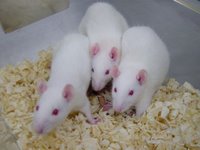
I do not think that being a laboratory animal is a great life for an animal, however, nor do I think that it is the worst fate an animal can suffer. I would personally much rather be a laboratory rat than a cow or a chicken that is slaughtered to become food for us. There are a number of reasons why animal research is not as bad as some people want us to believe. First of all, only in a minority of all the conducted experiments do the animals experience any pain, and when they do they are nearly always given anesthetics (one exception to this is when pain is the research subject in which case it is a necessary evil). Secondly, researchers, in order to get good data, must make sure that their animals are feeling well. Data from sick laboratory animals is worthless. Of course, the well being of laboratory animals is also inspected by committees on a regular basis and labs which do not take proper care of the animals will be shut down. Thirdly, for me, personally, working with laboratory animals actually made me value animals more than before. Rats are, believe it or not, smart playful and social, and working with them have made me more concerned about animal welfare in general. I now buy ecological meat, eggs from free outdoor hens (free walking indoor is no good either!), and in general try to buy products that have not caused unnecessary pain for any animals. This brings me to my next point.

I often hear from different people that many animal experiment that are carried out are unnecessary. To some extent I agree, I think that animal experiments that are done to develop new cosmetics are definitely unnecessary, let us use what we have got and spare these animals. Nevertheless, to conduct an experiment involving animals at a university one have to argue, very convincingly, that the research can further our knowledge in some way, and one must justify any hypothetical pain that the animals must endure. It is also not true that there are other methods that we could use just as well as animal research. Sure, studies can be done in vitro (that is, in a dish), but today these methods cannot replace animal research.

In the end I guess it all comes down to what your values are. Is it worth it to sacrifice laboratory animals in order to develop medicines that can cure us as well as animals. My answer is yes, but I don't think it is entirely obvious, so think for yourself. Perhaps we should be content with just living 48 years instead of around 75 years, and perhaps we should just accept that some diseases will kill us (I am not being sarcastic here).

I want to end with a list of some of the discoveries that would not have been possible was it not for animal research, you can find a much longer list and more information about animal research here. Our dept to laboratory animals, as you can see from the list below (remember this is not a complete list), is indeed great. The laboratory animals have helped us alot, and for that they deserve our respect, but should we stop doing these types of experiments?

Vaccines: Anthrax, Smallpox, Polio, Yellow fever, Measles, Hapatitis, Whooping cough...

Drugs: Insulin, Antibiotics, Birth control pills, pain killers, anti malaria drugs, chemotherapy...

Treatable conditions: Anemia, PKU, Herpes, Allergies, Chlamydia...

Life prolonging treatments: Diabetes, Epilepsy, Leukemia...

Other major discoveries: DNA, Virus, Electron microscope, ECG, EEG, Pacemaker, Artificial hips, x-rays, monoclonal antibodies, ultrasound, MRI, Artificial limbs, Effects of smoking alcohol and drugs, How lifestyle affects health

Surgery: Blood transfusions, Coronary bypass, Organ transplants, Breast cancer